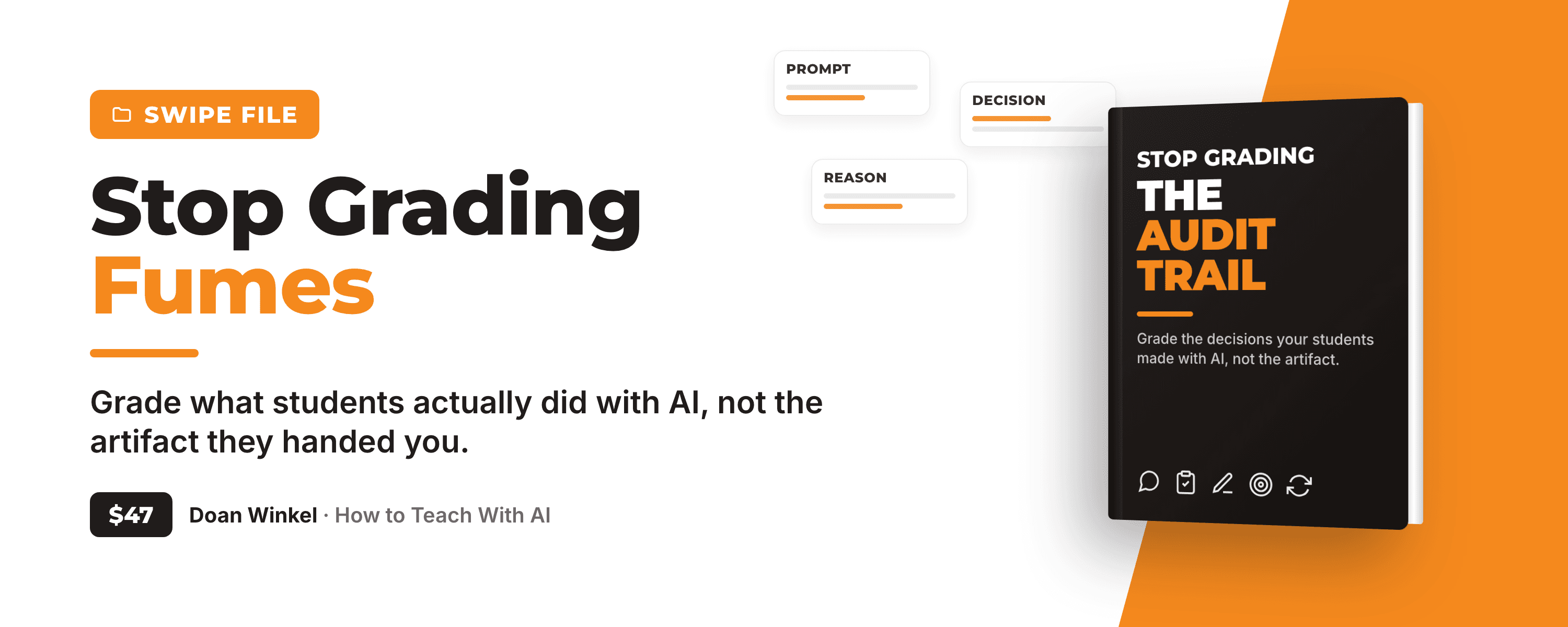
The essay came back clean. You have no idea who wrote it.
Stop trying to police the artifact. Grade the trail of decisions the student made while working with AI, which is the thing you have been trying to measure all along and the one thing AI cannot hand them in a single prompt.
Yours forever. Delivered the second you pay.
Three teachers this was built for
If one of these is you, the next ten minutes of reading will feel personal.
The detector refugee
You ran the detection software. It flagged your most careful international student and cleared the paper you were actually worried about. You are done with that game.
The instruction rewriter
You have redesigned the same assignment three times to make it AI-proof, and every version got completed by ChatGPT anyway. You are tired of losing an arms race you never signed up for.
The process believer
You already suspect the thinking matters more than the artifact. You just need a way to see the thinking that does not double your grading time.
It was not built for catching cheaters. If you want surveillance, this is the wrong $47. It changes what you ask for so the graded thing is the thinking itself.
Who is selling you this
I am a professor of entrepreneurship at John Carroll University and the Founding Director of the Bill & Sue Donnelly School of Leadership and Social Innovation. I cofounded the Experiential Entrepreneurship Curriculum, used at about 200 colleges. More than 20,000 teachers read my newsletter, How to Teach With AI.
I grade trails in my own courses. The student entry quoted further down this page is the kind of paragraph the system produces, a decision and a reason no chatbot wrote, and no rubric I used before would have caught.
You graded one standalone artifact and called it learning.
You do not know what they read. You do not know what they thought first and threw out. You do not know which sentences came from a flash of insight at 2pm and which came straight from ChatGPT at midnight.
That was always the deal, and before AI you could live with it, because the artifact at least came from the student. Now the artifact can be completely decoupled from the thinking.
Detection software loses. Better assignment instructions lose. You cannot out-design the fact that AI will produce any output you ask a student to produce.
Grade the trail instead.
An audit trail is the record of decisions a student makes while working with AI. The prompts they wrote, the outputs they kept, the outputs they killed, and the reason for each choice, captured while the choice is still live.
A student can ask AI to fake the trail too. A low-effort fake is easy to catch, and a high-effort fake costs roughly what doing the work costs. That is the whole trick.
A sample trail entry
- Decision
- Modified
- Reason
- The ranking assumed isolation is only social. I reframed my prompt to separate social isolation from academic isolation, because my real interest is students who fall behind, not students who feel lonely.
That paragraph is the assignment, and no rubric you use today would have caught it.
The whole loop, in four steps
- 1
Add the four-field trail to one assignment you already grade.
- 2
Tell students the trail is worth more than the artifact.
- 3
Score the trail against six observable rules, about two minutes per student.
- 4
Require a What Changed note, and run the Monday starter if you want a clean first try.
Everything is copy-paste. You can run the first piece in your next class without rewriting a single assignment.
The seven sections
Each one is paste-ready. The prompts are written out in full, with the bracketed inputs marked.
The Audit Trail Format
The four-field entry students fill in every time they make a real decision with AI: the prompt, the output, the call they made, and why. Paste-ready handout with a worked example.
The Assignment Wrapper
Language that makes the trail the graded object rather than extra credit, plus a prompt that converts an assignment you already use without changing your learning goal.
The Six-Rule Rubric
Six observable thresholds you score instead of judging polish. Thickness floor, rejection ratio, prompt evolution, reason quality, dissent, and the override bonus.
Spotting a Faked Trail
The four tells of a fabricated trail, and a prompt that flags one for your review without making an accusation. You keep the final call.
The What Changed Note
A 150-word note contrasting the Day 1 belief with the Day 7 belief. The single hardest thing in the system to fake.
Team Trails
Three extra fields that expose who thought and who coasted: whose decision it was, what dissent got logged, and what resolved it.
The Assignment You Can Run Monday
A complete starter assignment, already wrapped, so your first try does not have to be a rebuild of something you care about.
What this will not do
It will not catch cheaters. Detection is the game you were already losing. This changes what you ask for so that the thing worth grading is the thing that got produced.
It will not survive being bolted on as extra credit. If the trail is worth 10 percent, students will treat it like it is worth 10 percent, and you will have added busywork to both of your lives.
And you do not have to convert your whole course. Take one assignment you already grade and run it once this semester.
Questions people ask before buying
How do I get it?
Checkout runs through Stripe. The second you pay, you land on the product itself, a page you bookmark and keep forever. Lose the link and one email to doan@betterteacherwithai.com gets it back.
What do I need?
Nothing new. The trail is a format students fill in wherever they already work, and the scoring takes about two minutes per student with the six-rule rubric. The prompts run in any chat AI.
Does this add work for students?
It moves work rather than adding it. The trail replaces the performance of writing-alone-at-midnight with a record of real decisions, and a high-effort fake costs about what doing the work costs. That trade is the whole design.
I don't teach writing. Does it transfer?
Trails attach to any assignment where students use AI: code, analyses, designs, research memos. The four fields are about decisions, and every discipline has those.
Why $47?
Because the alternative is another detection subscription your institution pays for annually that still cannot tell you who thought. This is one payment, and the method does not expire when the models improve.
Seven sections, every prompt written out, the student handout, the six-rule rubric, and a starter assignment you can run Monday. Yours forever, and it works on every course you teach from here on.
Get Stop Grading FumesSecure checkout through Stripe. You get it immediately after payment.
This is also included in Better Teacher with AI Pro, along with the app, the workflow hub, and every other system I have built, from $29 a month.
See the Pro tiersThe stack is coming either way
In December you will sit down with forty clean, competent, interchangeable papers and try to guess which students learned anything. You will guess wrong, and you will know you guessed wrong, and you will submit the grades anyway.
Or one assignment this semester comes back with the thinking attached, and you grade what actually happened.
Nobody is asking you to rebuild your course. One assignment. You already know which one.
Get it for $47