Your AI policy is a paragraph nobody enforces.
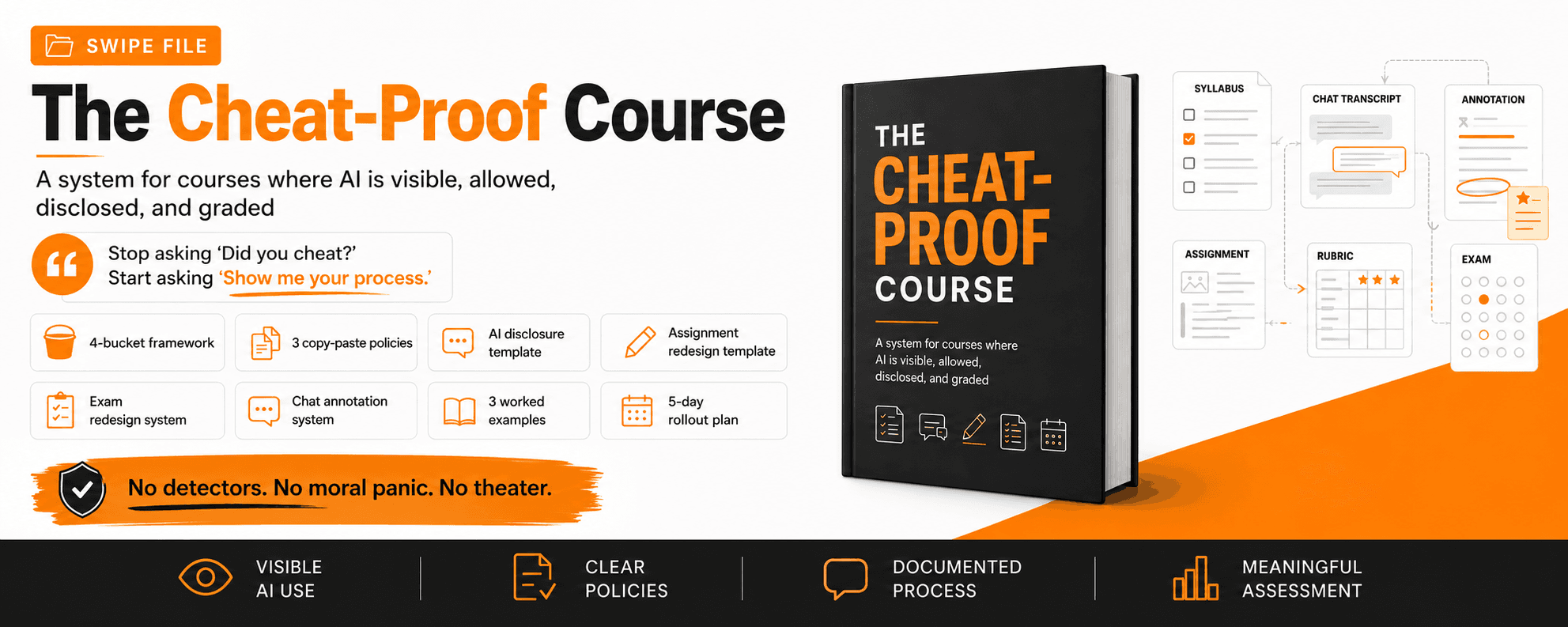
Stop asking whether they cheated and start asking them to show their process. The full system for a course where AI is visible, allowed, disclosed, and graded, from your syllabus through your final exam.
Yours forever. Delivered the second you pay.
Three teachers this was built for
Self-select. This page gets specific fast, and it should be specific about you.
The paragraph owner
Your AI policy is one paragraph you wrote in August, nobody has read since, and you quietly hope never gets tested, because you are not sure what you would do.
The B-minus-with-doubts grader
You have held a paper you were almost sure ChatGPT wrote, had no evidence, and graded it anyway. You would like to never be in that position again.
The policy writer for others
Your department or committee asked you to draft the AI policy, and you would rather adapt three working ones than invent from a blank page.
It was not built for teachers hunting a better detector. There isn't one, and this masterclass does not pretend to be it.
Who is selling you this
I am a professor of entrepreneurship at John Carroll University and the Founding Director of the Bill & Sue Donnelly School of Leadership and Social Innovation. I cofounded the Experiential Entrepreneurship Curriculum, used at about 200 colleges. More than 20,000 teachers read my newsletter, How to Teach With AI.
My own courses run on the four-bucket policy in this masterclass, with AI use visible, disclosed, and graded. The worked examples are not hypotheticals; they are the before-and-after of material that got rebuilt and taught.
You wrote the policy in August and have not enforced it once.
It says something about using AI ethically and maintaining academic integrity. No student has read it since week one. You are not sure what you would even do if you caught someone, because you are not sure how you would catch them.
So you run detectors that flag your careful international students and miss the confident cheaters. You rewrite assignment instructions that ChatGPT completes in one call anyway. You give the speech about how they are only cheating themselves.
None of it changes what happens at 11pm the night before the paper is due.
Four buckets, all of them explicit.
Almost every AI policy on a college campus does one thing: prohibit. A better one adds permission. Almost none of them do all four buckets, and the missing two are the ones that actually change student behavior.
Allowed tells students what will not get them flagged, so your cautious students stop freezing and avoiding the tool entirely. Required makes their use visible and traceable. Prohibited draws the hard line and names the consequence. Process Evidence asks for the inspectable artifact, the chat snippet or the annotation, that turns invisible work into something you can grade.
Write all four in plain language a first-year student follows without a law degree. That is the spine, and every component in the masterclass hangs off it.
The five-day rollout
- 1
Pick the policy that matches your authority: single course, department, or institution. Paste it in and edit the brackets.
- 2
Add the disclosure template as a required appendix on every submitted assignment.
- 3
Wrap one assignment you already use in the AI-visible redesign template.
- 4
Run the exam-redesign stress-test on the assessment you trust least.
- 5
Ship the chat annotation assignment and grade the thinking instead of the artifact.
Everything is written out and paste-ready. You are editing brackets, not building from scratch.
The eight components
Three worked before-and-after examples run through the whole system so you can see it applied before you touch your own course.
The Four-Bucket Framework
Allowed, Required, Prohibited, Process Evidence. The spine every component below hangs on, and the reason most policies fail.
Three Copy-Paste Policies
Single course (cautious), department (moderate), institution (AI-integrated). Pick the one that matches your authority and ship it Monday.
The AI Disclosure Template
The short appendix every submitted assignment carries. Disclosure is never penalized. Failing to disclose is the integrity issue.
The Assignment Redesign Template
Wrap any existing assignment in one step, with a paste-ready prompt that does the rewrite without changing your learning goal.
The Exam-Redesign System
Five exam patterns that survive AI, a stress-test prompt to run against your current exam, and a student handout.
The Chat Annotation System
The centerpiece. Turn AI transcripts into evidence of thinking, with a full assignment, an annotation key, and a ten-point rubric.
Three Worked Examples
Before and after for a writing essay, a data project, and a midterm exam. The whole system applied to material that looks like yours.
The Five-Day Rollout Plan
From a policy that is theater to your first AI-visible assignment shipped, in a single work week.
What this will not do
It will not catch cheaters. No detector works, and this masterclass does not pretend to be one. It changes what you ask for so the thing worth grading is the thing that gets produced.
It will not survive a policy you never mention again. If you paste it into the syllabus and skip the ten-minute conversation in week one, students will treat it exactly the way they treat the rest of the syllabus.
And you do not have to convert your whole course. One policy, one assignment, one exam. Pick the one that has been bothering you.
Questions people ask before buying
How do I get it?
Checkout runs through Stripe. The second you pay, you land on the masterclass itself, a page you bookmark and keep forever. Lose the link and one email to doan@betterteacherwithai.com gets it back.
Is this a video course?
No videos, no modules to complete. It is the working system: three policies, every template and prompt written out, three worked examples, and the five-day rollout. You could ship the policy this week.
Will my institution let me use this?
The three policies are tiered by authority on purpose: one for your single course, one for a department, one for an institution. You pick the one you have the standing to ship, and the course-level one needs nobody's permission.
What do students need?
Whatever AI they already use. The system makes that use visible and disclosed rather than pretending it is not happening, and disclosure is never penalized. Failing to disclose is the integrity issue.
Why $47?
One academic integrity case eats more hours than this costs dollars, and the case resolves nothing for the next assignment. This rebuilds the conditions so fewer cases arrive.
Eight components, every prompt and policy written out in full, three worked before-and-after examples, and a five-day rollout. Yours forever, and it works on every course you teach from here on.
Get the Cheat-Proof CourseSecure checkout through Stripe. You get it immediately after payment.
This is also included in Better Teacher with AI Pro, along with the app, the workflow hub, and every other system I have built, from $29 a month.
See the Pro tiersThe semester starts either way
In November you will hold a paper you are almost sure was written by ChatGPT, with no evidence, no process to point at, and no policy you actually want to invoke. You will give it a B minus and feel bad about it.
Or your students hand in their thinking alongside their work, because you asked for it in week one, and the question of whether they cheated stops being a question you have to answer alone.
You already know which assignment worries you. Start there, and leave the rest of the course alone.
Get it for $47